
Do Turtle Eggs Have Tiny Bodyguards?
Turtle eggs contain communities of tiny microbes. Learn how bacteria and fungi may affect turtle health and hatching success.
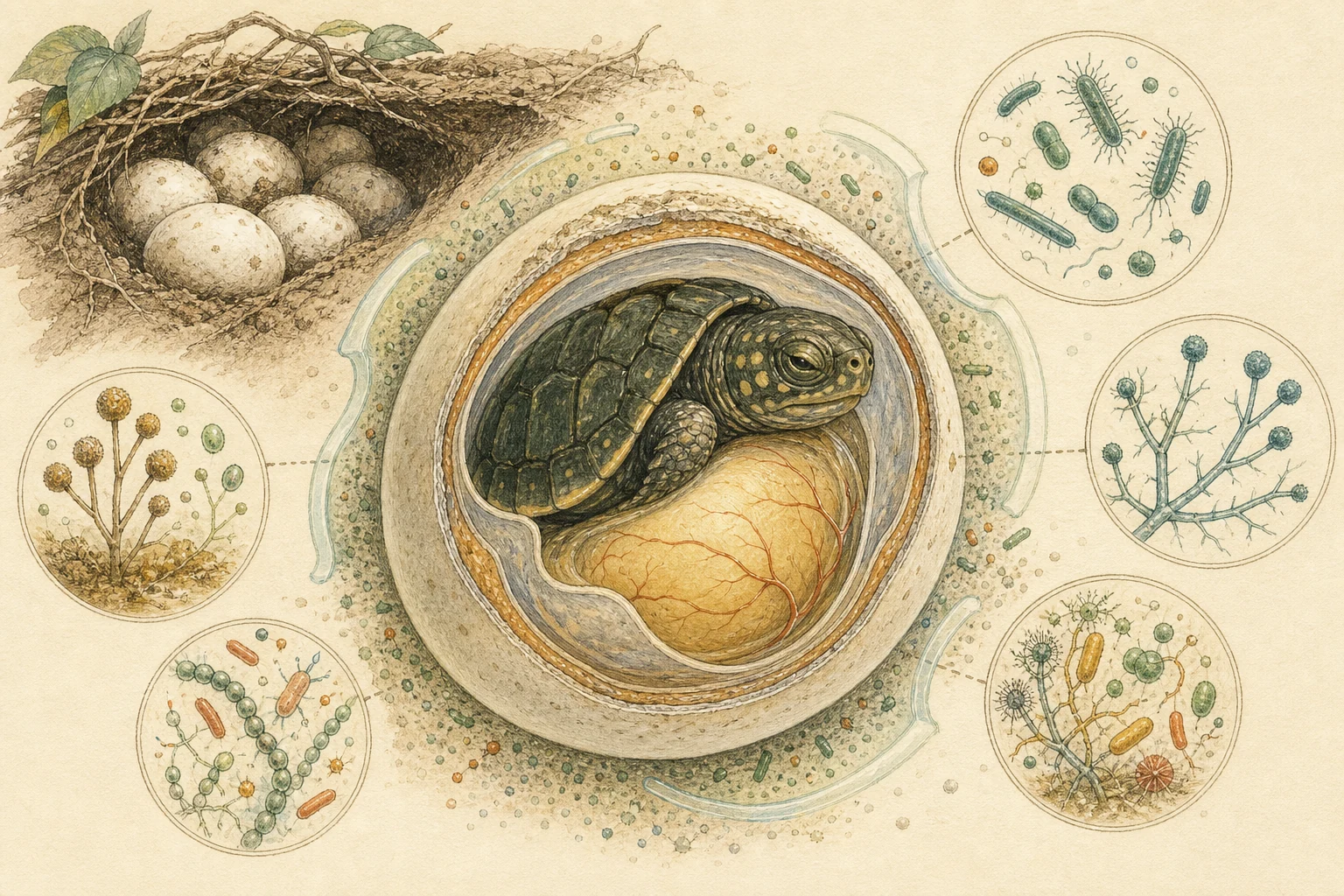
A turtle egg contains a community of microscopic organisms that may be connected to its health and hatching success.
Quick answer: A turtle egg contains a tiny community of bacteria and fungi. Some of these microbes may help it stay healthy.
A baby turtle is not completely alone inside its egg.
The egg contains a tiny world of bacteria, fungi and other living things. They are so small that people need special equipment to see them.
These tiny living things are called microbes. A community of microbes sharing one place is called a microbiome.
Scientists studied the microbiomes of yellow-spotted Amazon river turtle eggs. They wanted to understand why some eggs hatched successfully while others became sick.
What did the scientists discover?
A harmful fungus can attack turtle eggs and stop baby turtles from developing or hatching.
The researchers examined 127 samples from 31 turtle nests. They found that eggs with a greater variety of microbes were more likely to hatch successfully.
Some microbes were also connected with lower amounts of the harmful fungus.
Are these microbes really bodyguards?
Maybe—but scientists are still learning.
Helpful microbes might compete with the fungus for food or space. They might make it harder for the fungus to grow.
It is also possible that a varied microbiome is simply a sign that an egg is already healthy.
The research found an important connection, but it did not prove that adding certain microbes will save every turtle egg.
Why does this discovery matter?
Yellow-spotted Amazon river turtles face threats including habitat loss and the collection of their eggs.
If scientists learn what helps turtle eggs remain healthy, conservation teams may eventually protect more nests and help more baby turtles hatch.
Sometimes, helping a large animal begins with understanding the smallest living things around it.
Big science word — Microbe: A living thing so small that it cannot be seen without special equipment.
Think like a scientist
Imagine shrinking until you are smaller than a grain of sand. What might a turtle egg’s microscopic neighbourhood look like?
Turtle egg FAQ
Are all bacteria bad?
No. Many bacteria are harmless, and some may be helpful.
Are all fungi harmful to turtle eggs?
No. Different fungi can have very different effects.
Can scientists add helpful microbes to turtle nests?
Not yet. More research is needed to learn which microbes help and how they interact.
Discover turtles and tortoises and learn about reptile conservation through West Coast Exotics’ educational presentations in Metro Vancouver.
Research source: Communications Biology: Turtle egg microbiome and hatching success
 Bring the questions with you
 Ready for a Wild Encounter?
Tell Kevin about your date, group and location. He’ll reply with availability and your full quote.
Check Your Date