
How Does a Corn Snake Get Its Colours?
Discover how pigment cells create corn snake colours and reptile patterns. A simple explanation of new reptile science for children and families.
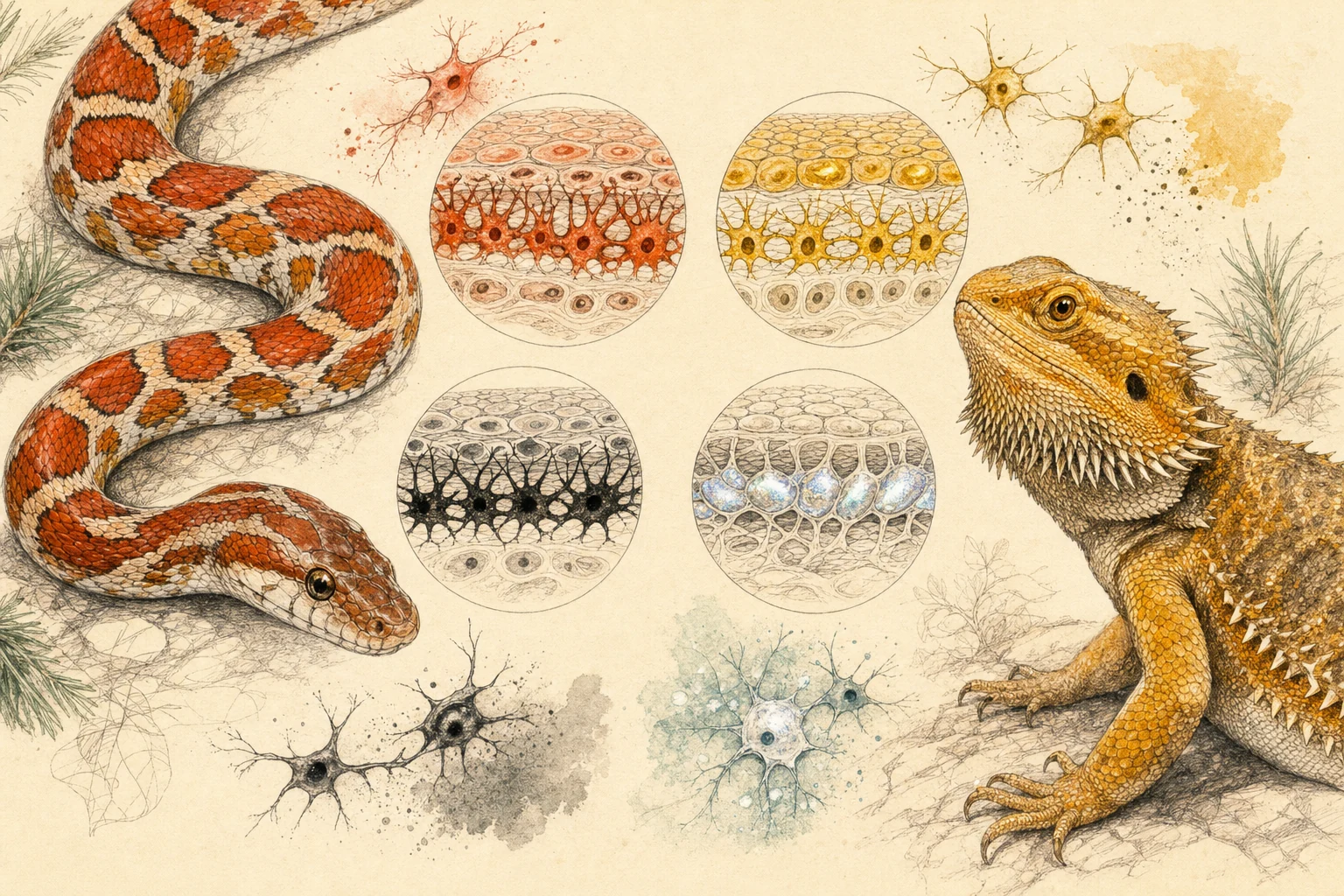
Special pigment and light-reflecting cells work together to produce reptile colours and patterns.
Quick answer: Special cells in a reptile’s skin work together to make its colours and patterns.
A corn snake does not need paint to create its beautiful spots.
Its colours begin developing before it hatches.
Scientists recently studied developing corn snakes and bearded dragons. They wanted to understand how reptiles build their colourful skin.
The answer begins with special cells called chromatophores.
Some of these cells create dark colours. Others create red or yellow colours. Another type reflects light.
Together, these tiny cells create the animal’s final colours and patterns. It is a little like a team of artists working beneath the reptile’s skin.
Nature uses different colour recipes
Corn snakes and bearded dragons have some similar colour-making cells, but the cells do not always develop in exactly the same way.
Imagine two people using similar ingredients to bake different cakes. The ingredients may be alike, but each recipe produces a different result.
Over many generations, evolution can change these biological recipes. This helps explain why reptiles have so many different colours, spots, stripes and bands.
Why do reptiles need colours?
Reptile colours are not just decorations. They can help an animal:
- hide among leaves, rocks or sand;
- avoid predators;
- sneak closer to food;
- communicate with other animals;
- absorb or reflect heat from the sun.
A corn snake may look bright inside a home. Among dry leaves, its orange and brown markings can make it surprisingly difficult to see.
Big science word — Pigment: A material that gives a living thing its colour.
Think like a scientist
You are designing a snake that lives on a forest floor. Which colours and patterns would help it hide?
Reptile colour FAQ
Can a corn snake change its entire pattern?
No. Most of its pattern is built into its skin as it develops.
Do chameleons change colour only to hide?
No. Colour can also communicate temperature, health, mood or social signals.
Why are some reptiles brightly coloured?
Bright colours may communicate, attract attention or warn another animal to stay away.
Explore a Wild Encounter and meet colourful reptiles during a West Coast Exotics educational animal presentation in Metro Vancouver.
Research source: Nature Communications: How reptile colour cells develop
 Bring the questions with you
 Ready for a Wild Encounter?
Tell Kevin about your date, group and location. He’ll reply with availability and your full quote.
Check Your Date